

Uboat: Sea War
Anisoft Yazilim Derya Bagdinli ve Ort. Koll. Sti.
Uboat: Sea War immediately puts me in a very particular mood: enclosed, tense, and patient. Rather than presenting naval combat as a constant fireworks display, it frames the submarine as a place where every decision feels deliberate. I spend much of my time thinking about position, timing, and the danger of acting too quickly. That makes this free action game a more thoughtful choice than its category label might suggest.
After spending time with it, I would describe it as a focused submarine-war experience for players who enjoy pressure building slowly before a decisive moment. The central appeal is not simply launching attacks. It is the feeling of operating beneath the surface, reading a situation, and deciding whether the opportunity in front of me is worth the risk. The game’s setting, visual direction, and measured rhythm work together well enough to make that idea convincing.
It is developed by Anisoft Yazilim Derya Bagdinli ve Ort. Koll. Sti., and its store presence shows a 4.4 average from around twenty-eight thousand ratings, with more than five hundred thousand installs. Those figures suggest that the concept has found a substantial audience, but they do not replace the more important question: does the moment-to-moment play suit you? In my experience, the answer depends heavily on whether you want a quick arcade battle or a slower naval encounter where preparation matters.
My first hours beneath the surface
The strongest first impression comes from the setting. A submarine is naturally suited to suspense because the player is powerful without being comfortable. I can feel protected by the water one moment and exposed the next. That contrast gives ordinary actions more weight. Moving, waiting, and choosing when to commit all feel connected to survival rather than being separate menu tasks.
I also appreciate that the game does not need to make every second loud to keep my attention. The quiet stretches are part of its identity. They create room for anticipation, which makes an eventual encounter feel more meaningful than a battle that begins immediately after every loading screen. Players who enjoy a gradual build-up will probably understand the appeal quickly.
Related News






The free entry point makes it easy to test that rhythm without committing money first. The game is marked for Teen players, so it is better approached as a war-themed action title rather than a light, all-ages pastime. It runs on Android devices using version 7.0 or later, which gives it a reasonably broad starting point for people using older compatible hardware.
One practical detail I noticed is that the current version is 0.7.3. That is worth keeping in mind when judging the presentation and balance. I approached it as an evolving game rather than a completely settled naval simulation. That mindset helps, especially if you are sensitive to rough edges or expect every system to feel as polished as a long-established premium release.
A setting that rewards patience
The submarine setting is more than a decorative skin placed over ordinary action mechanics. It changes how I read the space. Open water can feel empty, but here that emptiness becomes information. A quiet stretch gives me time to consider what might be happening outside the immediate view. The result is a kind of playable uncertainty: I am not only reacting to visible targets, I am managing what I do not know.
Gallery
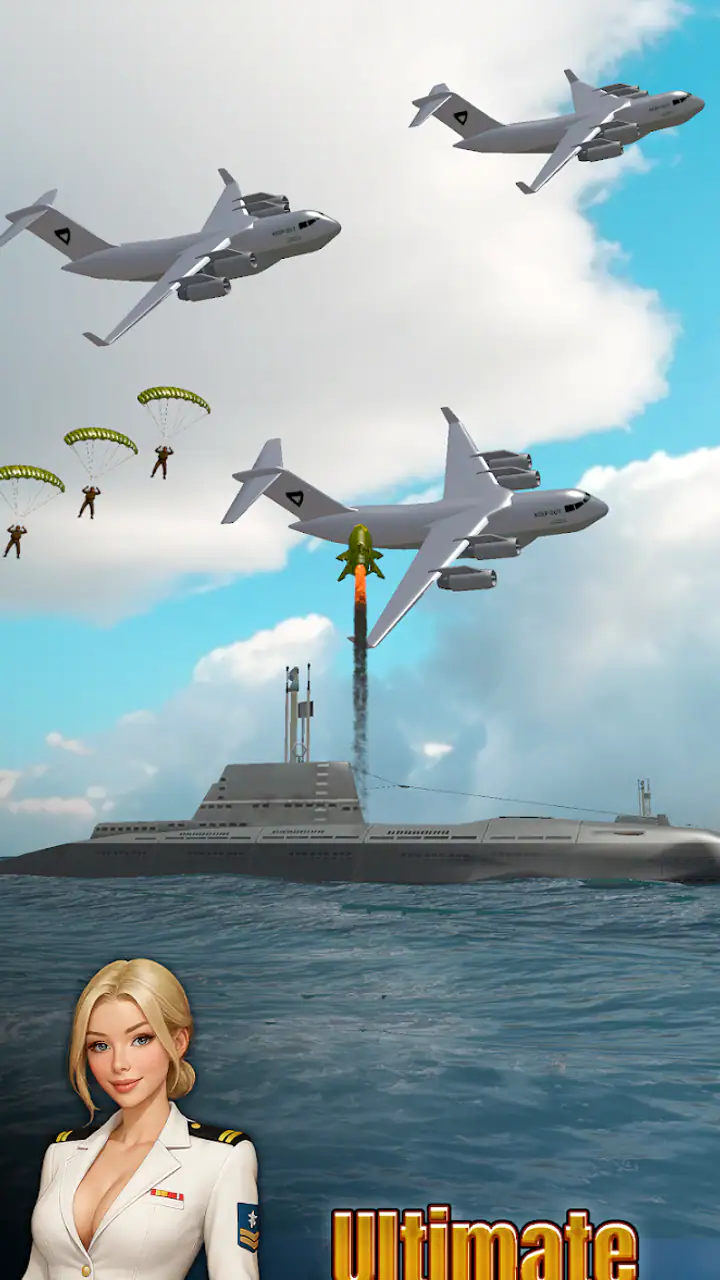
This is also where the game separates itself from many faster naval action alternatives. In a typical arcade-style sea battle, movement and firing are often the whole conversation. Here, the atmosphere encourages me to treat movement as part of the attack itself. A poor approach can make a later strike feel rushed, while a careful approach gives me more control over the encounter.
That does not mean every player will enjoy the restraint. If you want immediate explosions, constant enemy contact, or a short session with no waiting, the underwater setting may feel like a brake rather than a benefit. The game asks me to accept its tempo before it gives me its best moments.
The world speaks through art and space
The art direction works because it supports the submarine fantasy without trying to turn the game into a bright, disposable spectacle. The sea is not merely a background behind combat. It creates a visual language of distance, concealment, and limited certainty. I find myself paying attention to the relationship between the vessel and its surroundings, even when there is no immediate target demanding a response.
That visual restraint also helps the action stand out. When the environment is not overloaded with decoration, a change in the situation feels clearer. A new contact, a dangerous approach, or a sudden opening has room to register. The game’s mood depends on this contrast between long periods of observation and brief moments of urgency.
For me, the most effective use of the setting is the way it changes my sense of time. On land, waiting can feel like a pause between real events. Underwater, waiting is part of the event. I am still making choices while apparently doing very little. That is a difficult feeling for an action game to create, and it gives this one a recognizable personality.
Why the atmosphere matters to play
The coherent mood is not just a visual bonus. It affects how I make decisions. A tense environment makes reckless movement feel less attractive, while a calm stretch encourages me to plan rather than tap through an encounter. This is one of the game’s less obvious strengths: the presentation quietly teaches me to slow down.
I found it useful to treat each engagement as a small sequence instead of a single attack. First I observe the situation, then I consider my approach, and only afterward do I decide whether to act. Even when the game does not explicitly frame the experience in those terms, the atmosphere makes that workflow feel natural. It is a good habit for players who tend to rush into combat and then blame the controls for a poor result.
Another useful approach is to separate a successful attack from a successful encounter. Landing a hit may feel satisfying, but the larger question is whether the action leaves me in a safer position. Thinking this way makes the submarine setting mechanically relevant. I am not chasing spectacle; I am trying to preserve control over what happens next.
The trade-off is that the world can feel narrow if you need constant variety. A submarine war setting has a strong identity, but it also places limits on visual and mechanical contrast. Players who prefer colorful environments, rapid character movement, or a broad range of locations may find the focused presentation repetitive over longer sessions.
Sound gives the battles their breathing room
Sound plays an important role in making the underwater setting believable. The best moments are not necessarily the loudest ones. A restrained audio backdrop gives silence a purpose, allowing me to feel that the submarine is isolated from the surface world. That sense of separation supports the game’s central tension more effectively than a nonstop action soundtrack would.
I pay more attention to changes in the audio environment because the overall rhythm leaves space for them. When the game moves from quiet observation toward danger, the shift feels like part of the encounter rather than a random effect layered over it. This is a subtle design choice, but it helps the action retain a clear emotional shape.
I would recommend playing with sound enabled, especially during a first session. The visual information matters, but the audio helps preserve the mood that makes the game distinctive. If I play while distracted or with the sound removed, the experience becomes easier to treat as a basic targeting exercise. With the sound present, the same pauses feel more intentional.
A rhythm built around tension
The pacing is probably the feature that will divide players most sharply. Uboat: Sea War is at its best when I allow an encounter to develop. The game gives tension time to gather, then lets a decision release it. That rhythm makes a well-timed action feel earned instead of automatic.
It also changes how I use short sessions. I would not choose this game when I have only enough time for a few instant matches and want guaranteed excitement from the first tap. A realistic everyday use case is a quiet break after work, when I can give one encounter my attention without needing to multitask. The game suits that kind of focused pause better than a commute where interruptions are likely to break the buildup.
There is a second use case for players who enjoy replaying a situation mentally. After an encounter goes badly, I can usually identify a decision that deserves reconsideration: acting too soon, approaching without enough care, or treating an opening as more valuable than it really was. That reflective quality gives the action more staying power than a simple win-or-lose loop.
However, the same pacing can make a poor first session feel uneventful. New players may expect the store summary, “The Ultimate Uboat War Game!”, to promise immediate large-scale action. I think it is better to approach the game as a tense submarine action experience with a deliberate tempo. That expectation is more accurate and leads to a fairer judgment.
Where the mechanics fit the mood
The game’s mechanics are most convincing when they reinforce concealment and timing. I feel encouraged to think before acting, which is exactly what the setting needs. The submarine is not interesting merely because it is underwater; it is interesting because the underwater position changes the value of information and patience.
One practical tip is to avoid treating every visible opportunity as an instruction. When I see a chance to attack, I first ask whether the situation is actually favorable. That small pause prevents the common action-game mistake of confusing availability with necessity. In this game, restraint can be an active choice rather than a failure to engage.
A second tip is to use the quiet portions to prepare mentally for the next decision. Instead of waiting passively, I consider what I will do if the encounter changes. This makes the game feel less reactive and helps reduce the frustration of being surprised. It is a simple workflow, but it fits the submarine fantasy unusually well.
A third insight concerns the relationship between atmosphere and difficulty. Because the game creates suspense through uncertainty, a mistake can feel larger than its mechanical cost. I try not to judge a session only by whether I won. If I understood why a decision failed, the encounter still taught me something useful. That mindset is especially valuable for players who enjoy learning through repeated attempts.
Free access and purchase decisions
The game is free to download, with in-app purchases ranging from forty-nine cents to forty-four dollars and ninety-nine cents per item. I would advise new players to spend time understanding the basic loop before buying anything. The atmosphere and pacing are the main reasons to stay, and no purchase can make a player enjoy a slow, tense submarine game if that style is not a good fit.
I also prefer to view optional spending as a convenience decision rather than a requirement for discovering the game. The sensible approach is to ask whether a purchase improves a routine I already enjoy, not whether it will solve a lack of interest. That distinction matters here because the core appeal comes from decision-making and mood, not simply from collecting more powerful options.
For families, the Teen rating should be part of the decision. It signals that the war setting is not aimed at very young children. I would be comfortable recommending it to a teenager who already enjoys action games with a serious tone, but I would choose something lighter for a child who mainly wants colorful, uncomplicated play.
How it compares with familiar naval action games
Compared with fast arcade naval games, this one feels less interested in constant motion and more interested in anticipation. Arcade alternatives are usually better when I want quick feedback, frequent targets, and a clear burst of excitement in every short session. Uboat: Sea War is the better choice when I want the setting itself to shape my behavior.
It also differs from highly detailed submarine simulations. A full simulation may offer more technical depth, more complex procedures, and a steeper learning curve. This game is easier to approach as an action title, but that accessibility comes with a trade-off: players seeking exhaustive realism may find the experience too streamlined. I see it as a middle ground, using submarine tension without demanding that I study every aspect of naval operation.
Compared with turn-based strategy games, it offers a more immediate sense of danger. I am not simply calculating from a safe overview; I feel closer to the unfolding encounter. The cost is that I have less time to analyze every possibility. That balance makes it appealing to players who want thoughtful action rather than pure planning.
The most important comparison is therefore about mood. If your favorite part of naval games is the explosion, another option may satisfy you faster. If your favorite part is the approach before the explosion, the uncertainty of the sea, and the pressure of choosing a moment, this game has a clearer reason to exist.
Who should play it and who should skip it
I recommend it to players who enjoy war-themed action with a controlled pace, atmospheric presentation, and decisions that feel more important because they are not made constantly. It is particularly suitable for someone who likes to replay an encounter, identify a mistake, and try a more careful approach next time.
It is also a good fit for people who want a free game they can sample without immediately buying a premium release. The broad Android compatibility helps, and the established audience shown by its rating activity makes it easier to see that the title has reached beyond a tiny niche. I would still judge it by your tolerance for waiting and uncertainty rather than by popularity alone.
I would skip it if you need rapid action from the opening seconds, dislike war settings, or prefer games where every pause is filled with a new objective. I would also look elsewhere if you want a deep simulation with extensive technical management. The game’s strength is its focused interpretation of submarine combat, not its ability to satisfy every naval preference at once.
My final atmosphere verdict
What stays with me is the consistency between the game’s setting and its playable rhythm. The art direction creates a restrained underwater world, the sound gives silence room to work, and the pacing turns waiting into a meaningful part of action. Those elements would not matter much if the mechanics encouraged careless rushing, but the game generally points me toward observation and timing instead.
That coherence is the reason I would recommend Uboat: Sea War to a friend who wants naval action with a darker, more patient mood. I would explain that it is not a conventional rapid-fire arcade game and not a demanding full simulation. It sits between those approaches, using the submarine setting to make ordinary action decisions feel tense.
The limitations are clear: the deliberate tempo can feel slow, the focused environment may not provide enough variety for everyone, and the evolving version means some players may prefer to wait for a more settled experience. Still, those reservations do not erase the game’s identity. They define it.
My advice is to play with sound on, resist the urge to attack every opportunity, and give the first few encounters enough attention to understand their rhythm. If that process feels rewarding rather than frustrating, you have found the audience this game is built for. If you only want immediate spectacle, a faster naval alternative will probably be a better use of your time.
My recommendation is simple: choose it for atmosphere-led submarine action, not for instant arcade noise. At no cost to start, it is easy to try, and its strongest qualities become apparent when I let the sea stay quiet long enough for the tension to build.
FAQs for Uboat: Sea War
What is Uboat: Sea War about?
Uboat: Sea War is a naval strategy game centered on submarine warfare. You command a crew, search for enemy vessels, plan attacks, manage limited resources, and try to survive dangerous missions beneath the surface. The game combines tactical decision-making with progression elements, so success depends not only on firing torpedoes, but also on choosing the right route, timing, and escape strategy.
Is Uboat: Sea War suitable for beginners?
The game is accessible to newcomers, although its submarine-focused mechanics may take some time to understand. Early missions generally introduce navigation, targeting, combat, and upgrades step by step. However, players still need to pay attention to enemy detection, ammunition, and crew or vessel management. If you enjoy strategy games that reward patience rather than constant action, the learning curve should feel manageable.
Does Uboat: Sea War require an internet connection?
Whether an internet connection is required can depend on the specific version and the feature you are using. Basic gameplay may be available offline in some situations, but online connectivity can be necessary for advertisements, cloud synchronization, updates, events, or other connected services. Before downloading, check the current Google Play or App Store listing, especially if you plan to play while traveling or without reliable mobile data.
Is Uboat: Sea War free to download and play?
Uboat: Sea War can generally be downloaded without an upfront purchase, but free access does not necessarily mean that every feature is completely unrestricted. Mobile games commonly include optional in-app purchases, advertisements, or progression systems that can speed up upgrades and unlocks. Review the store page and your device’s purchase settings before playing, particularly if children use the device.
What devices are compatible with Uboat: Sea War?
Compatibility depends on the operating system, device model, available storage, and the minimum software version supported by the developer. Before installing Uboat: Sea War, open its official Google Play or App Store page and compare the listed requirements with your phone or tablet. Keeping the operating system updated and having sufficient free space may also help prevent crashes, slow loading, or installation problems.
Pros
- Easy-to-learn controls make submarine missions accessible to newcomers.
- Multiple mission objectives add variety beyond simply sinking enemy ships.
- Underwater combat creates a tense
- strategic atmosphere.
- Short missions suit quick gaming sessions on mobile devices.
- Progression encourages players to improve targeting and tactical decisions.
Cons
- Some missions may feel repetitive after extended play.
- Enemy behavior can occasionally seem predictable.
- The interface may feel crowded on smaller phone screens.
- Progression could become slower without repeated grinding.
- Battery usage may increase during longer gameplay sessions.


